Circulation before quantity
A floor is not a list of machines. It is the paths between them. Decide how members move first, and the quantities answer themselves.
Choosing machines is the easy part. What decides whether a gym works is settled earlier, in the plan, in the lease and in how many people the floor can hold at once. We work that through with you, and then we source the equipment.
A supplier list arrives, the quantities look reasonable, and the order goes in. Then the free-weight area turns out to sit where the floor cannot take it, the cardio row blocks the route to the changing rooms, and the class studio is one metre too narrow for the format it was bought for. None of that is an equipment problem, and all of it is expensive once the floor is laid.
A floor is not a list of machines. It is the paths between them. Decide how members move first, and the quantities answer themselves.
Ceiling height, floor loading, power, ventilation and the width of the goods door rule out more configurations than budget ever does.
A reception that cannot see the floor, or a zone no one can supervise, is a layout decision your team pays for every shift.
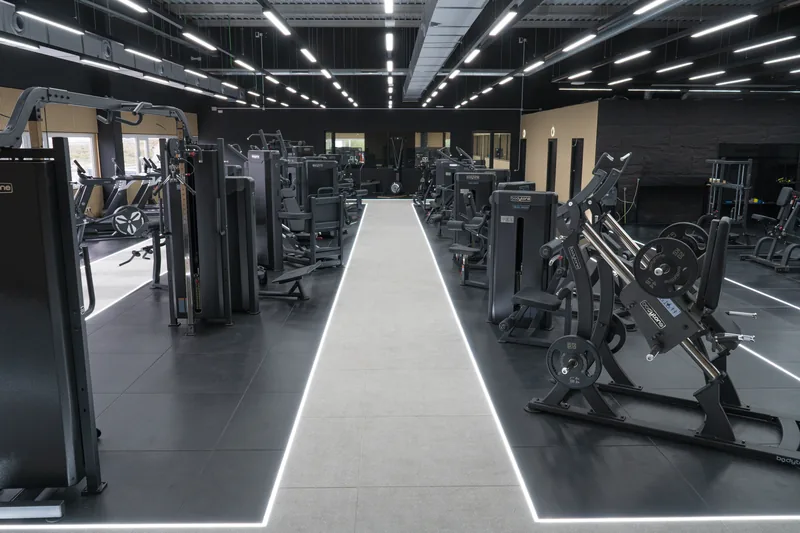
Not a catalogue, but the decisions a floor is assembled from. Which of these you need, and in what proportion, is what the plan decides:
| Zone | What it decides |
|---|---|
| Cardio | The entry point for most new members and the easiest zone to oversize. Consoles and connectivity matter more here than anywhere. |
| Selectorised strength | Guided machines for members who train without supervision. Low instruction cost per place, high durability requirement. |
| Free weights | Racks, benches, bars and dumbbells. The zone with the heaviest floor loading and the one most often planned too small. |
| Functional and open area | Floor space, a rig and storage. Cheap in equipment, expensive in square metres, and the zone that carries small-group formats. |
| Group studio | A room whose capacity is the product. Sound, light, flooring and sightlines decide whether a class sells out or empties. |
| Recovery | Stretching, mobility and regeneration. Small footprint, and the part members increasingly ask for by name before they join. |
| Reception and access | Access control turns opening hours into a decision rather than a staffing cost, and takes the queue off the desk at peak. |
| Management software | Memberships, bookings, lead follow-up and billing in one place. The difference between knowing your retention and guessing at it. |
| Cleaning and service robotics | Scheduled floor cleaning and routine front-of-house questions handled without taking an instructor off the floor to do them. |
Which zones a floor needs, and how much of each, follows from the space, the concept and the opening hours. We work that out against your plan before anything is quoted.
Equipment is bought per unit and sold per hour. What a gym actually sells is places at the times people want to train, and those times are narrow, early morning and after work. A floor that is generous at eleven in the morning and jammed at seven in the evening has a layout problem, not an equipment problem. Working out the peak first changes the quantities, usually downward on cardio and upward on free weights and open floor. That is the conversation worth having before a supplier list exists.
Whether a unit may be used as a gym at all is a question for the building authority and the landlord, not for a supplier, and it is decided locally. The same goes for floor loading, which governs where free weights can go, and for ventilation and power, which govern everything else. Ceiling height limits what can be racked overhead; the width of the delivery route limits what can be brought in at all. Get those confirmed in writing before the lease, because every one of them is cheap to answer now and very expensive to discover later.
We are not a catalogue and we do not carry stock. We work out what the floor needs with you, find the suppliers who can deliver it, and stay in the project until it is installed.
The same specification across sites, and what changes when it is repeated rather than built once.
Multi-site fit-outSmall rooms where capacity per class, sound and light are the product.
Boutique studiosRigs, flooring and free weights, and the circulation that decides how many people can train at once.
Functional areasEighty square metres that have to do the work of four hundred.
Small studiosTell us the space, the concept and when you want to open. You get a read on what fits and a written quote, not a catalogue.