Strength training is one of the most important components of modern fitness, health and physical performance. But how do we know whether someone is training with the right resistance?
Two people performing the same exercise may have completely different strength levels, movement capabilities and training goals. Even for the same person, the appropriate intensity changes as they progress, recover or accumulate fatigue.
That raises a practical question for operators and training professionals: how do you make strength training personalised, measurable and responsive to individual needs, without putting a coach next to every member for every set?
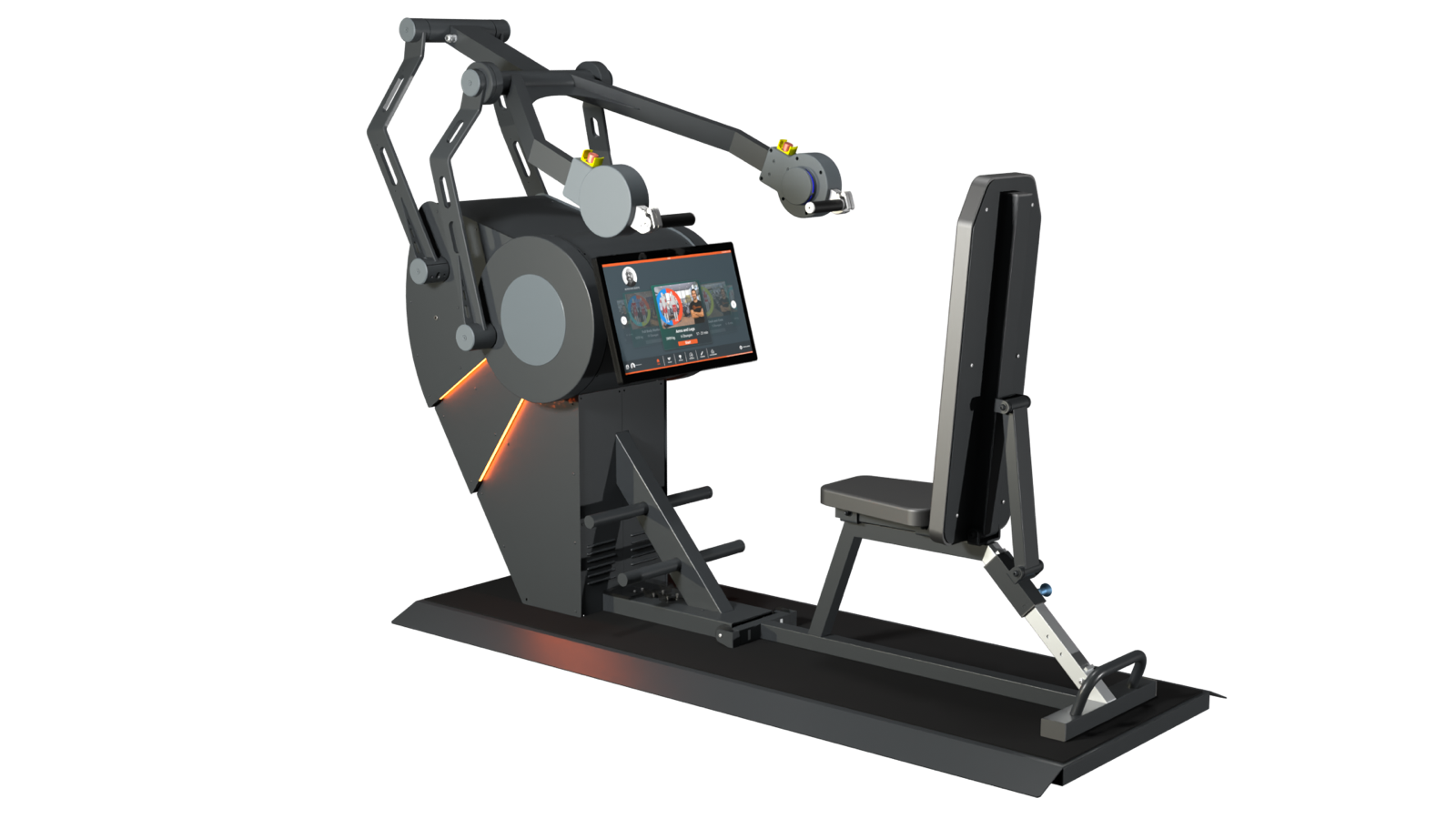
Instead of relying only on manually selected weights, modern systems can measure strength, analyse movement and adjust resistance according to performance. With Sparkfield Core, the German fitness technology company Sparkfield combines robotics, sensors and sports science into one unit.
This article is about the part that usually gets least attention: the measurement that comes before the training.
Why the right training resistance matters
One of the fundamental principles of effective strength training is applying an appropriate stimulus.
If the resistance is too low for a given goal, it may not provide the intended challenge. If it is unnecessarily high, technique suffers, fatigue rises and the session becomes harder to manage.
The objective is not the heaviest possible weight. It is a resistance that matches the person's current capability, their objective and the demands of the exercise.
Someone beginning a programme may benefit from moderate resistance and controlled movement. An experienced athlete may need a very different load to keep developing maximal strength. A person working with a qualified physiotherapist may need carefully controlled resistance and movement ranges as part of an individual rehabilitation plan.
The right resistance is therefore not a universal number. It is a training decision that depends on the individual.
Strength testing: understanding capability before training
A well-designed programme starts with understanding the person who will follow it.
Traditional assessments involve repetition-based tests, estimated maximum strength or supervised performance evaluations. These give valuable information, but they take time, need appropriate supervision and depend on consistent procedure.
Intelligent equipment offers another route: putting the assessment inside the training system.
With Sparkfield Core, strength testing is part of the digital onboarding process. The system uses sensors and force measurement to evaluate individual performance, and that information can support the choice of training load and the design of a personalised programme.
For trainers, measurable assessment offers several practical advantages:
- An initial performance baseline that does not depend on memory or estimation.
- Resistance selected against actual strength rather than assumption.
- Changes in performance visible over time.
- More consistent progression between sessions and between staff.
- Results that are easier to explain to a member.
None of this removes the need for professional judgement. Good coaching still requires reading movement quality, understanding individual limitations and knowing the objective. What reliable measurement adds is a better basis for those decisions.
Adaptive resistance: when the equipment responds to the user
A conventional strength machine applies a resistance that is mechanically defined for the whole exercise. The force the body actually experiences varies with leverage and machine geometry, but the machine does not respond to what happens during the repetition.
Adaptive resistance works differently. Sparkfield Core uses electric drives and force measurement to control both resistance and movement, applying software-controlled force rather than generating it from a weight stack. That force can be set to the exercise, the individual strength profile and the chosen training method.
A fuller account of how the unit reads the person using it is in our earlier piece on technology that adapts to the user.
Why strength changes inside a single movement
Muscle force is not constant across an exercise. Joint angle, muscle length, biomechanics and direction of movement all influence how much force a person can produce at a given position.
Think of a pressing movement. One section usually feels harder than the rest, even though the external weight has not changed. With a fixed load, the weight ends up chosen for the hardest part of the range, which means the rest of the movement is loaded below what the person could handle.
Variable resistance can distribute load along the movement path instead, and respond to performance and fatigue according to how the system is programmed.
It is worth saying plainly that adaptive resistance is not automatically better for every goal. Free weights and conventional machines remain effective ways to build strength, and they are considerably cheaper. The case for intelligent equipment rests on control, customisation and the performance information it produces, not on the resistance itself being superior.
What Sparkfield publishes about the system
The figures below are the manufacturer's own.
| Manufacturer's specification | What Sparkfield states |
|---|---|
| Resistance | Generated by electric drives and controlled through software, not by weight stacks |
| Measurement | Force and movement captured during the exercise |
| Footprint | Approximately 2 m² for the unit |
| Exercises | More than 30 validated exercises in the current edition, for upper body, core, back and lower body |
| Training methods | Eccentric overload, isokinetic and isometric training, supersets and drop sets |
| Testing and approval | Endurance and stress testing completed in early 2023, with CE certification |
Two cautions belong with that table. The exercise count has risen across editions, so earlier material cites a lower number: the figure that matters is the one for the configuration you are actually quoted. And the 2 m² is the unit, not the installation. Real space requirements have to include access, circulation, safe operation and how the unit sits in the surrounding layout, which is the same calculation as for any other piece of a gym floor.
Different goals need different resistance strategies
Not every member trains for the same outcome. Some want maximal strength. Others prioritise muscle development, general fitness, movement quality or maintaining physical function with age.
Software-controlled resistance lets one platform support several methods:
- Eccentric overload applies a heavier load during the lowering phase of a movement.
- Isometric training holds muscle activation at defined positions without substantial movement.
- Isokinetic training holds movement speed constant.
- Supersets and drop sets are selected through the interface rather than reconfigured by hand.
The point is not that more methods become available in the abstract. It is that a facility can offer different training approaches from one platform, and a trainer can change method without changing station.
From a single test to measurable progress
Measuring strength once is useful. Measuring how it changes is what makes training legible.
A member starting a programme may not see visible physical change for weeks. Improvements in force production, exercise performance or training capacity arrive earlier and can be shown.
With recorded data across sessions, a training process can follow four stages:
- Initial assessment. Onboarding and strength tests establish a starting point.
- Personalised training. The programme is configured to capability, exercise requirements and objective.
- Progressive adaptation. As strength develops or performance changes, load and programme are adjusted.
- Performance review. Recorded information helps coach and member evaluate progress and plan the next phase.
That structure makes strength training easier for a member to understand and easier for a professional to monitor. It also gives a facility something concrete to build a service around, which is where the commercial argument starts. We set that argument out separately in the business case for smarter strength training areas.
Where this fits: gyms, studios and clinics
The relevance differs by setting.
A boutique studio or micro-studio can build personalised strength packages around regular assessments, where the measurement is part of what the member is paying for.
A larger gym can use measurable onboarding to make the first weeks of a membership less daunting, which is where many new members are lost.
A corporate fitness facility can run structured programmes with participation and performance indicators that mean something to the employer paying for them.
A physiotherapy practice can use precisely controlled resistance within an appropriate clinical framework, where the clinical decisions stay with the professional and the equipment supplies the control and the record. What a practice is permitted and required to provide is set by its professional body and its payer, not by a supplier, which is the same principle that governs any equipment decision in a therapy setting.
What to evaluate before buying
Before investing in intelligent strength equipment, look past the specification sheet.
- How are initial strength assessments performed, and how long do they take?
- How does the system determine and adjust resistance?
- Which training methods are available, and will your team use them?
- What information can trainers actually access, and in what form?
- How intuitive is onboarding for a member who has never used the system?
- What does installation need in terms of space, power and access?
- What do software support, updates and staff training cover?
- How does the equipment fit the business processes you already run?
A live demonstration answers more of these than any brochure. Feeling the resistance, using the interface and watching a member go through onboarding tells you quickly whether the technology suits your audience.
Better strength training starts with better information
Strength training has always depended on choosing suitable exercises, applying appropriate resistance and progressing over time. What is changing is the information available to support those decisions.
Precise strength testing, real-time force measurement, adaptive resistance and digital progress monitoring create new possibilities for personalised training. Sparkfield Core brings those capabilities into one multifunctional system.
For members, that can mean a more individualised and more transparent experience. For trainers, more information and more flexibility in designing programmes. For operators, a way to differentiate a service and build concepts around measurable progress.
One thing is worth keeping in view, though. The best programme is still the one a person actually sticks with. Technology earns its place when it makes that more likely, not merely when it measures more precisely.
Discover Sparkfield Core with FitLink
At FitLink, we connect fitness operators, physiotherapy clinics, hotels and health-oriented facilities with innovative strength training solutions such as Sparkfield Core.
Interested in bringing intelligent strength training, objective strength assessments and adaptive resistance into your facility? Contact us at welcome@fitlinkglobal.com or book a video call with our team.
We would be happy to introduce Sparkfield Core and discuss how the technology could fit your facility and your business concept.