Duty cycle, not footfall
Peak concentration matters more than total visits. A club floor sits idle and then runs flat out, and the equipment has to be rated for the second half of that.
A club gym is not a quiet version of a commercial floor. It is the same equipment used harder, by more people, with a wider range of bodies on it, and usually with nobody permanently assigned to look after it. That changes what is worth buying.
In a commercial gym, use is spread across a membership that comes and goes. In a club it concentrates: squads arrive together, train the same patterns, and leave. The same bar gets loaded to the same weight forty times a week by people who are still growing, and the adjustment range has to cover a fourteen-year-old and a senior forward on the same afternoon. Equipment specified for average use does not last here.
Peak concentration matters more than total visits. A club floor sits idle and then runs flat out, and the equipment has to be rated for the second half of that.
Youth and senior squads share the room. What matters is the span a piece covers safely, not the maximum load it will ever see.
Most clubs have no full-time facilities staff. Equipment that needs attention to stay safe will not get it, so it has to be the kind that does not.
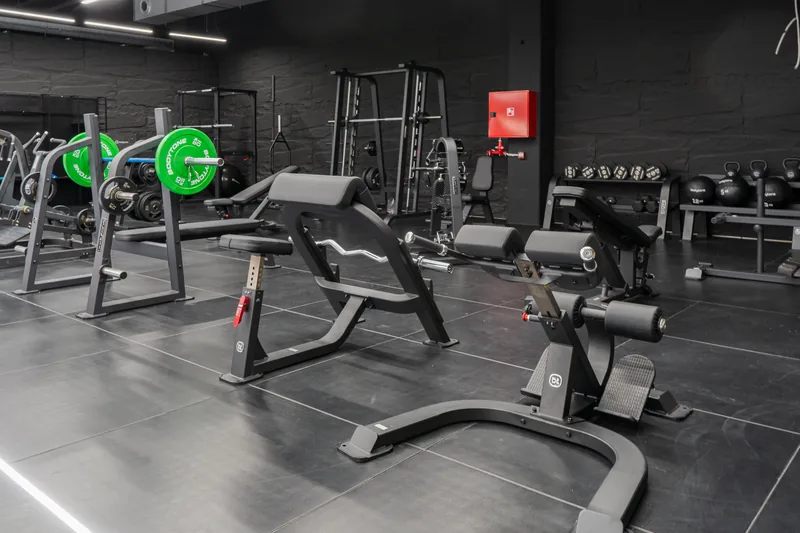
What a club actually needs, in the order it usually matters. How much of each depends on the sports, the squads and the hours:
| Element | What it decides |
|---|---|
| Strength base | Racks, bars, platforms and benches. The core of almost every club programme and the part that has to survive the heaviest use. |
| Free weights and storage | Range and increments wide enough for every squad, stored so that the room resets itself between sessions. |
| Conditioning and cardio | Rowing, bikes and sleds for conditioning blocks. Chosen for throughput in a timed circuit rather than for a cardio floor. |
| Speed and movement area | Clear floor for warm-up, mobility and movement work, which is where a squad session actually starts and ends. |
| Testing and monitoring | Whatever the coaching staff will actually use and record. Equipment nobody has time to operate produces no data. |
| Recovery | Space and equipment for the part of the session most clubs plan last and athletes ask about first. |
| Access and scheduling | Which squad has the room when, and who can get in outside those hours. Access control makes that a rule rather than a key. |
| Storage | Enough that the floor is clear for the next group without anyone tidying for twenty minutes. |
| Maintenance and spares | Parts that are easy to get and easy to fit, because the person fitting them is probably a volunteer. |
Which of these a club needs, and in what proportion, depends on the sports, the squad sizes and the hours the room is used. We work it through against your plan before quoting.
A club room is rarely short of space in the abstract. It is short of space between four and nine in the evening, when every squad wants it. That concentration is what should drive the quantities: how many athletes are in the room at once, how long a circuit takes to rotate, and how fast the room resets for the next group. Planned that way a club usually buys fewer, more robust pieces and more floor, which costs less and serves more athletes than a room filled with specialised equipment that is idle for most of the week.
Several things about a club facility are not a supplier's to settle. Supervision requirements for young athletes are a matter for the club and its governing body. Insurance conditions for an unsupervised room come from the insurer. Whether the building can take a lifting platform is a question for the building's owner and engineer. What we can do is make sure the equipment side is documented well enough that you can answer all three: certification class, loadings, installation requirements and the terms, in writing before you order.
Clubs rarely have a procurement department, and often have a committee instead. We make the equipment side straightforward enough that it can be decided and defended.
Tell us the sports, the squad sizes and the hours the room is used. You get a specification you can take to the board and a written quote.